Most US investors who reach into Japan for income do the easy part first—open a brokerage, buy the shares, watch the dividend land—and then run head-first into the part nobody briefs them on: a tax slip in yen, a withholding line they did not expect, and a quiet realization that their US 1040 is now talking to a foreign tax authority.
This guide is the part that gets skipped. It explains, in plain English, how Japanese dividend withholding actually works for a US resident: why the rate is 10% (and not 20.42%) under the US-Japan tax treaty, how to claim the Japanese tax back on your US return via the Foreign Tax Credit (Form 1116), and—just as practically—how to track all of it across brokers, currencies, and dividend dates so the numbers tie when April comes around.
It is written from a Japan-based vantage point for US and global investors, sourced from IRS publications, the US-Japan treaty itself, and standard Japanese-tax references. It is educational, not tax or investment advice—the disclaimer is at the end, and a US-licensed CPA should sign off on anything you actually file.
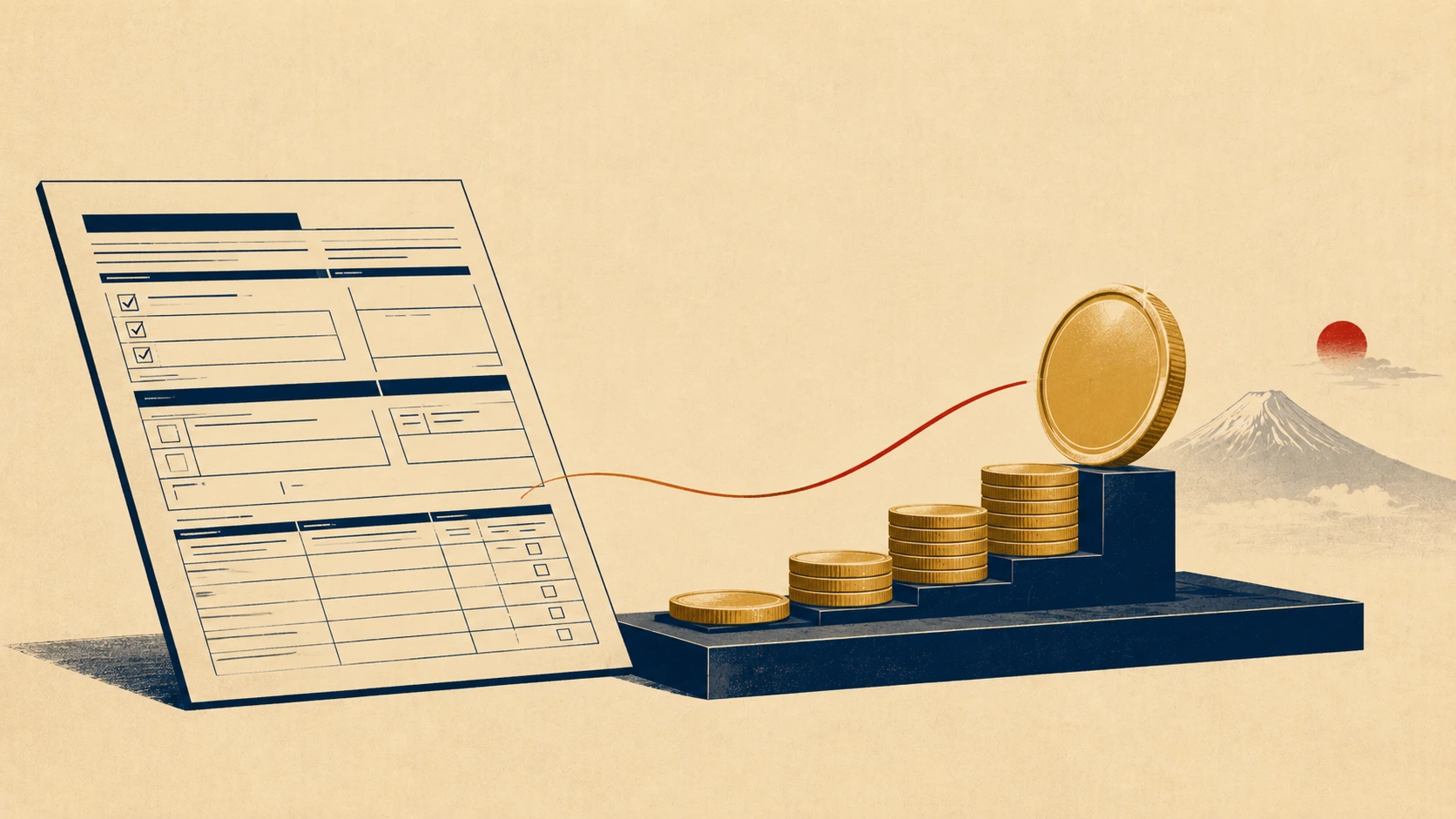
The US-Japan tax treaty: why the rate is 10% (not 20.42%)
Japan, like most countries, taxes dividends paid by its domestic companies to foreign shareholders at the source—the company (or its paying agent) withholds the tax before the cash ever leaves Tokyo. The starting point is Japanese domestic law, which sets a 20% national withholding tax on dividends paid to non-residents. On top of that, since 2013 Japan has applied a 2.1% special reconstruction surtax to most national withholding, which makes the effective domestic rate 20.42% (20% × 1.021). That is the rate a non-treaty foreign investor would see.
For a US resident, the operative document is not Japanese domestic law—it is the US-Japan Income Tax Convention, the treaty that overrides domestic withholding for residents of the other treaty country. The treaty's dividend article reduces the Japanese rate on portfolio dividends paid to a US resident to 10%. ("Portfolio" here is the key word: lower rates exist for direct corporate shareholdings of 10% or more, which a typical retail investor will never hit. We are talking about the 10% rate that applies to a US individual holding Toyota, Sakata INX, or any other listed Japanese stock in a normal brokerage account.)
- 20% national withholding on dividends to non-residents
- Plus a 2.1% special reconstruction surtax on the national tax
- Effective rate: ~20.42% (20% x 1.021)
- Applies if no treaty election is on file with your broker
- Reduced rate of 10% on portfolio dividends
- Available to US residents (and most US-domiciled accounts)
- Requires correct treaty documentation on file with the broker
- Half the cash leakage of the non-treaty default
The treaty rate is not a discretionary courtesy. It is the rate the United States and Japan agreed to apply, and it has been the default for US-resident portfolio investors since the treaty's modern incarnation took effect. The 20.42% rate is what you get if the paperwork is not in place—which, for US-resident accounts at major brokers, generally is in place by default.
That is the headline. The footnotes are where money gets left on the table.
What actually gets withheld: a worked example
The cleanest way to see this is in numbers. Imagine a US investor who holds 100 shares of a Japanese company that declares an annual dividend of ¥100 per share. The gross dividend is ¥10,000. Spot FX at the dividend payment date is, say, ¥150 = $1.00, so the gross dividend is roughly $66.67 in US-dollar terms before any tax.
Now run the same gross dividend through two regimes:
| Line item | 10% treaty rate | 20.42% non-treaty default |
|---|---|---|
| Gross dividend (JPY) | ¥10,000 | ¥10,000 |
| Japanese withholding tax | ¥1,000 | ¥2,042 |
| Net dividend received (JPY) | ¥9,000 | ¥7,958 |
| Net dividend received (USD, at ¥150) | ~$60.00 | ~$53.05 |
| Cash leakage vs gross | 10.0% | 20.42% |
A few things to notice. The 10.42-percentage-point gap is not theoretical—it is real cash that either lands in your account or is left in Tokyo. On a yield-oriented Japanese portfolio of any size, the compounding of that difference over years is meaningful. On a single ¥10,000 dividend it looks small; on a $50,000 Japanese sleeve yielding ~4%, you are talking about roughly $200 a year in cash leakage if the wrong rate is being applied.
The second thing to notice is that the Japanese withholding is on the yen dividend, not the dollar dividend. Your US 1099-DIV will eventually show the dollar equivalent, but the foreign tax was assessed in yen on a yen amount, on a Japanese pay date, at whatever spot FX the broker booked. That distinction matters when you fill out Form 1116, and it is the single biggest source of reconciliation errors at tax time.
What can go wrong: when 10% is not actually 10%
The treaty rate is the legal rate—but practical execution sometimes drifts. The most common cases:

- No treaty election on file. If your broker has not certified you as a US resident eligible for treaty benefits, the default Japanese rate (20.42%) may be applied. Major US brokers that offer Japanese equities (Interactive Brokers is the most common route for US retail) handle this as standard onboarding via the W-8BEN; some smaller or international brokers do not, and the extra ~10% just disappears unless you affirmatively claim it back.
- Wrong residency on file. If your broker thinks you are a resident of a country other than the US—because the address on the account, the tax-residency certification, or the W-8BEN says so—you may get that country's treaty rate, or none at all.
- Mutual-fund and ADR wrappers. Dividends from a Japanese-equity ETF or mutual fund domiciled outside Japan flow through their own withholding chain. The Japanese tax is withheld at the fund level, not on you directly; the fund may pass through a foreign-tax credit on the year-end 1099, but the mechanics are different from holding shares directly.
- Refund procedures for over-withholding. If 20.42% was withheld and you were entitled to 10%, claiming the refund involves a Japanese refund filing—a process most retail investors simply do not pursue because the friction outweighs the recovery. Better to get the treaty rate right at the source.
The takeaway is uncomfortably simple: check that the 10% rate is actually being applied in your broker's confirmations and year-end statements. If the line item says 20.42% or anywhere near it, something in the paperwork chain is wrong, and that is fixable—but only if you notice.
Claiming the Foreign Tax Credit (Form 1116) — at a high level
Once Japan has taken its 10%, the next question is what the US does with the rest. By default, US residents are taxed on their worldwide income—including foreign dividends—on the same Form 1040 they use for everything else. Without relief, you would be taxed twice: once by Japan at the source, and again by the US on the same dividend.
The US tax code resolves this through the Foreign Tax Credit (FTC), which lets a US taxpayer claim a credit (a dollar-for-dollar reduction in US tax) for foreign income taxes paid—or, in some cases, an itemized deduction instead. For most US investors with Japanese dividends, the credit is the right choice; the deduction is usually worse unless you have a peculiar tax profile.
The mechanics, in broad strokes—not as a substitute for a CPA:
- Report the gross foreign dividend on your Schedule B / Form 1040 as ordinary dividend income (the gross amount, before foreign withholding).
- Claim the Japanese tax already withheld as a foreign tax credit—either directly on the 1040 if you qualify for the de minimis exception (total foreign tax under roughly $300 single / $600 joint and meeting the other conditions), or on Form 1116 if you are above that threshold or have other foreign income to coordinate.
- Convert foreign tax amounts to USD using the spot rate on the date the tax was paid (or, in practice, a defensible method consistently applied—your broker's year-end 1099 typically does this for you).
- Coordinate with the qualified-dividend treatment, where applicable. Japanese companies are generally treated as qualified foreign corporations if listed on an exchange meeting US qualifications, which is the case for most TSE-listed names—but this is fact-specific and worth confirming for your particular holdings.
- Watch the limitation. The credit is capped at the US tax that would otherwise have been due on the foreign-source income. If the Japanese tax is below your US marginal rate on dividends, the credit fully offsets it; if it is above, the excess can carry over—within the rules.
That is the conceptual picture. The execution—especially Form 1116, with its source-of-income categories, look-through rules, and credit-limitation math—is genuinely complicated, and small mistakes in the high-tax kick-out election, the "passive category" classification of dividends, or the FX translation can produce wildly wrong answers. This is the section where a US-licensed CPA earns their fee, and where you should not try to be a hero in TurboTax with a five-broker portfolio. The article you are reading is here to make sure you understand the framework; the specific form is your tax professional's job.
Japan takes 10% at the source; the United States lets you credit most of that back on your 1040—but only if your records can prove which yen turned into which dollar on which Japanese pay date.
On the FTC, in one line
Tracking dividends across brokers and currencies
Here is the practical problem the IRS and your broker do not solve for you: in a normal year, a US investor with even a small Japanese-equity sleeve will receive a dozen or more dividend payments, on Japanese pay dates, in yen, converted at the broker's spot rate, with the foreign tax withheld at line-item granularity that varies by broker. Multiply that across brokers (one for US holdings, one for Japanese, perhaps a third for ADRs) and the tracking problem becomes the real workload.
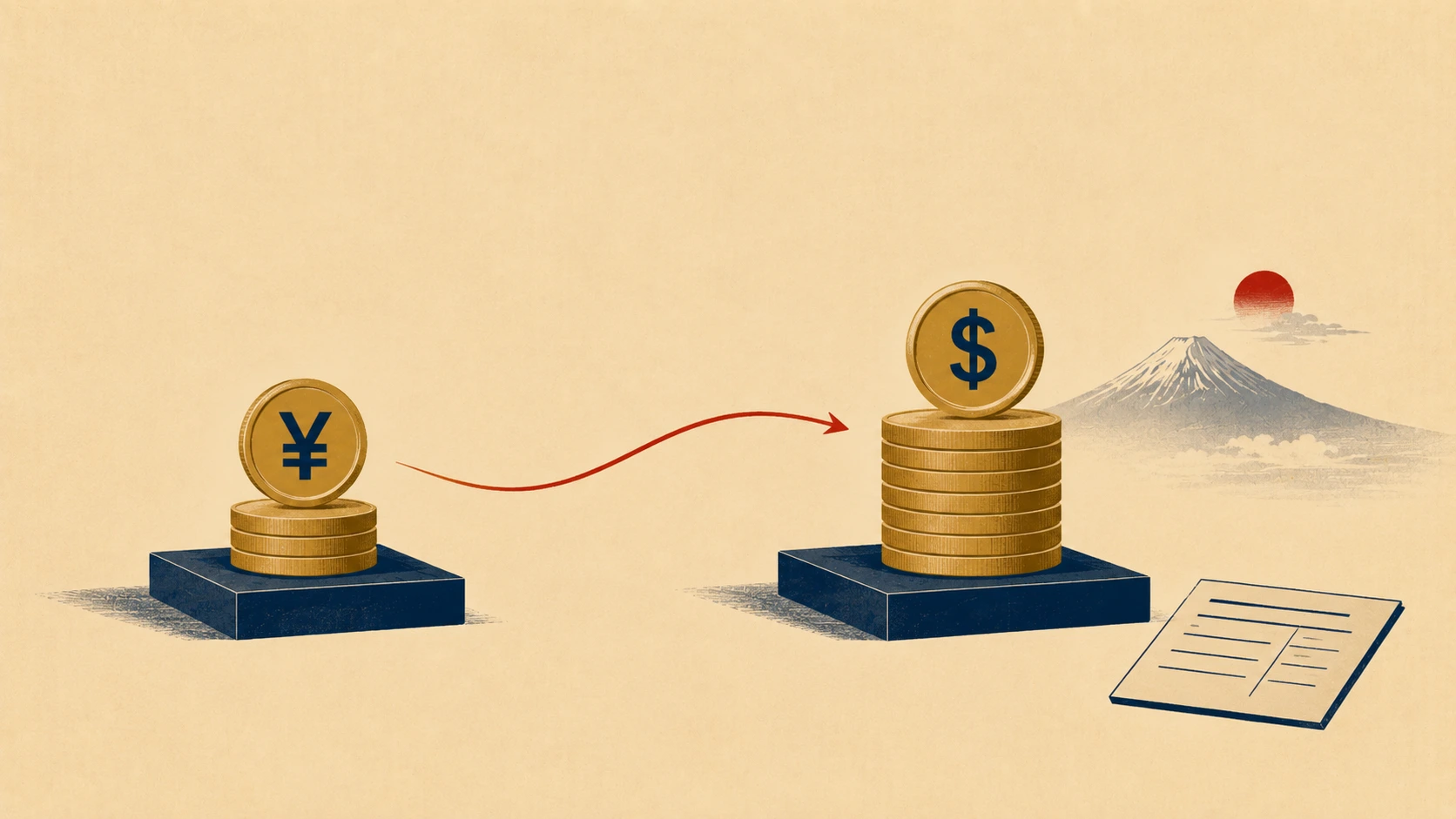
Two ways to handle it. They look different, and the difference compounds.
The manual route
You can do this in a spreadsheet. The spreadsheet needs columns for: ticker; pay date; gross dividend in JPY; FX rate; gross dividend in USD; Japanese tax withheld in JPY; Japanese tax withheld in USD; net received in USD; broker; account. You add a row every time a dividend lands. At year end you sum the foreign tax column, reconcile against each broker's 1099 or annual summary, and hand the totals to your CPA.
This works—plenty of investors have done it for years—but it has three failure modes. FX rates are easy to get wrong (pay-date spot vs settlement-date spot vs broker's booked rate). Brokers report differently, especially when one of them does not produce a US-style 1099 for foreign holdings. And the time cost compounds: a single year is annoying, five years of clean records for an audit or a sale-of-position event is a project.
The tool route
The alternative is a portfolio tracker that ingests dividend feeds across multiple brokers, holds each leg in its native currency, applies the correct FX rate at the right date, and produces foreign-tax and dividend reports in your reporting currency. The dominant tool in this niche—and the one most often mentioned by international dividend investors—is Sharesight, which integrates with major brokers (including Interactive Brokers), handles the JPY/USD reconciliation natively, and produces dividend summaries and a foreign income report that maps reasonably cleanly to the inputs Form 1116 expects. Note that the multi-currency valuation and foreign income report sit on Sharesight's paid tiers (Starter / Investor / Expert); the free plan is capped at 10 holdings and does not include the tax-ready foreign-income report. For a US investor with a serious Japanese sleeve, the paid tier is the relevant comparison.
There are alternatives (some investors live in a personal-finance app like Snowball Analytics, others in their broker's reporting console). The point is not the specific tool; the point is the separation of concerns—a dividend tracker should be designed for multi-currency, multi-broker dividend tracking. A bank statement and a US-style 1099 are not.
| Dimension | Manual spreadsheet | Portfolio tracking tool |
|---|---|---|
| Setup time | ~30 min one-off | ~15 min, including broker links |
| Ongoing time per dividend | A few minutes; manual FX lookup | Zero; auto-ingested from broker feed |
| FX accuracy | Depends on your discipline | Pay-date spot, applied consistently |
| Multi-broker handling | You merge the data yourself | Native; treats each broker as a feed |
| Foreign-tax-credit support | You sum the column manually | Foreign income report, ready to share with CPA |
| Audit trail | Only as good as your sheet | Timestamped, exportable, multi-year |
| Cost | Free (your time) | Free up to 10 holdings — foreign income report and multi-currency valuation require Sharesight's Starter plan or above |
For a US investor with two or fewer Japanese holdings, the manual route is fine. For anyone with a real dividend sleeve—say, the kind of portfolio described in Japan's high-dividend portfolio note (May 2026)—the tool route pays for itself in saved hours and reduced tax-time stress within a single year.
Common mistakes US investors make with Japanese dividend tax
Speaking from my own experience as a Tokyo-based dividend investor who has been working through Japanese yen payouts and US filings for roughly a decade, the first year I held Japanese stocks in a non-Interactive Brokers account I overlooked the W-8BEN treaty box and watched 20.42% leave my dividends instead of 10%. It is an entirely avoidable mistake, and it is the most common one I see in reader emails too. Most of the problems on this subject are not exotic—they are the same handful of unforced errors, repeated:
- Assuming 20.42% is the rate you have to live with. If your broker shows the 20.42% rate (or anywhere near it) on a dividend confirmation, your treaty election is missing or wrong, and you are leaving roughly half the recoverable tax in Tokyo. Fix the paperwork before you fix anything else.
- Forgetting to claim the FTC at all. A surprising number of US investors with small Japanese sleeves under the $300/$600 de minimis line never claim the credit—either because their tax software did not surface it or because they did not realize the 10% in the "foreign tax withheld" column was claimable. That is free money walked away from.
- Filing Form 1116 themselves on a complex year. If you have multiple foreign sources, carryovers, or AMT exposure, the calculation is fiddly. The cost of a CPA review is small relative to the cost of mis-applying the FTC limitation.
- Treating ETF and direct-share dividends identically. A Japan-equity ETF held in a US account passes through foreign taxes via the fund's 1099. Direct shares of a Japanese company arrive with withholding already taken. Both are creditable in principle; the documentation chain is different. Your CPA will care about which is which.
- Ignoring the currency layer. The Japanese tax is in yen; the US credit is in dollars. Sloppy FX translation can create either over-credit (an audit risk) or under-credit (lost money). Use the broker's booked rate, applied consistently, and document the methodology.
- Conflating Japanese dividend withholding with Japanese capital-gains tax. Capital gains on listed Japanese equities, for a US tax-treaty resident, are generally taxable only in the US under the treaty (not in Japan)—a different rule from the dividend article. Mixing the two is a common confusion when reading Japanese-broker reports. (Article 13 of the treaty does carve out exceptions—shares of Japanese real-estate-rich companies and JREITs, for example, can still be taxable in Japan on disposal. Worth knowing if your Japanese sleeve includes REITs.)
The thread running through these is mundane: records, paperwork, and consistency. There is no exotic structuring trick here; there is only making sure the treaty rate is being applied, the foreign tax is being captured cleanly, and the FX translation is defensible.
Frequently asked questions
- What is the Japanese dividend withholding tax rate for a US investor?
- Japan's domestic rate is 20.42% (a 20% national tax plus a 2.1% special reconstruction surtax). Under the US-Japan tax treaty, the rate on portfolio dividends paid to a US resident is reduced to 10%. The 10% rate is what most US-resident accounts at major brokers will see by default, provided treaty documentation (the W-8BEN equivalent) is on file.
- Can I claim a US foreign tax credit for the Japanese tax withheld on my dividends?
- Yes, in most cases. Japanese tax withheld on dividends is generally creditable on your US return under the Foreign Tax Credit rules, up to the US tax that would otherwise have been due on that foreign-source income. Smaller amounts (roughly under $300 single / $600 joint of total foreign tax) can be claimed without Form 1116. Above that threshold, Form 1116 is typically required. Confirm specifics with a US-licensed tax professional.
- Do I have to file Form 1116 to claim the Japanese tax back?
- Not always. If your total foreign tax is under roughly $300 single / $600 joint and the other de minimis conditions apply, you can claim the credit directly on Form 1040 without Form 1116. Above those limits, or if you have multiple foreign income categories or carryovers, Form 1116 is generally required. The form is genuinely complex and best handled with a CPA.
- What happens if my broker withheld 20.42% instead of 10%?
- It means your treaty election was not on file when the dividend was paid. Going forward, fix the W-8BEN (or your broker's equivalent) so the 10% rate is applied at source. For the over-withheld amount on past dividends, there is a Japanese refund procedure, but the friction is high and most retail investors absorb the over-withholding rather than pursue it. The priority is to prevent it from happening again.
- What is the best way to track Japanese dividends across multiple brokers?
- A spreadsheet works for one or two holdings. Beyond that, a dedicated portfolio tracker that handles multi-currency dividend feeds and foreign tax reporting—Sharesight is the most common option among international dividend investors—saves a meaningful amount of reconciliation time and produces a foreign-income summary that maps cleanly to what your CPA needs for Form 1116. Note that Sharesight's multi-currency valuation and foreign income report are paid-tier features (Starter and above); the free plan is capped at 10 holdings and does not include the tax-ready foreign-income report. For a US investor running a real Japanese sleeve, the paid tier is the relevant baseline.
Bottom line
Japanese dividends are not a tax minefield. They are a regime that asks you to do three things and then leaves you alone: get the 10% treaty rate applied at source, capture the foreign tax cleanly across brokers and currencies, and credit it against your US tax via the FTC. Do those three and the cash leakage drops to roughly the irreducible 10%—not 20.42%—and your reporting is straightforward enough for any competent CPA to handle.
The work is not glamorous. It is paperwork, record-keeping, and a willingness to read a year-end statement carefully. But the difference between doing it well and doing it badly is real money on every dividend payment, every year, compounding for as long as you hold the position. For an investor building a Japanese income sleeve—whether that is a single name like Sakata INX (4633) or Kamigumi (9364), or a broader portfolio along the lines of the May 2026 high-dividend note—the time spent getting the tax plumbing right is among the highest-return work in the entire process.
Ten percent goes to Tokyo. Everything else, with the right paperwork and the right records, is yours.
Disclaimer: This article is educational and does not constitute tax, legal, or investment advice. US tax law is fact-specific and changes; consult a US-licensed CPA or tax attorney before filing. Withholding rates, treaty positions, and de minimis thresholds cited reflect publicly available IRS and PwC guidance at the time of writing and may change.
- IRS — About Publication 514, Foreign Tax Credit for Individuals
- IRS — About Form 1116, Foreign Tax Credit (Individual, Estate, or Trust)
- IRS — Japan Tax Treaty Documents
- IRS — US-Japan Income Tax Convention (treaty PDF)
- PwC Worldwide Tax Summaries — Japan: Corporate Withholding Taxes
- Sharesight — portfolio tracking with multi-currency dividend and foreign-tax reporting