Ask a US dividend investor to name a Japanese stock and you will usually get Toyota, Sony, or one of the trading houses Warren Buffett bought. Almost no one names Kamigumi (TSE: 9364)—and that is precisely why it is worth a careful look.
Kamigumi is the largest port-logistics operator in Japan: the company that physically moves cargo through the country's busiest harbors. It is the kind of unglamorous, infrastructure-like business that rarely makes headlines but quietly compounds—and it has just made a structural change to how it returns cash to shareholders that fits squarely into the broader Japanese governance story.
This is a company profile and analysis for educational purposes. It is not a recommendation to buy or sell anything. The disclaimer is at the end.

What Kamigumi actually does
Founded in Kobe and still headquartered there, Kamigumi is a "one-stop" port and harbor logistics company. When a ship arrives at a Japanese port, a long chain of work begins: unloading (stevedoring), customs clearance, temporary warehousing, in-plant processing, and onward transport by truck or rail. Kamigumi does all of it under one roof.

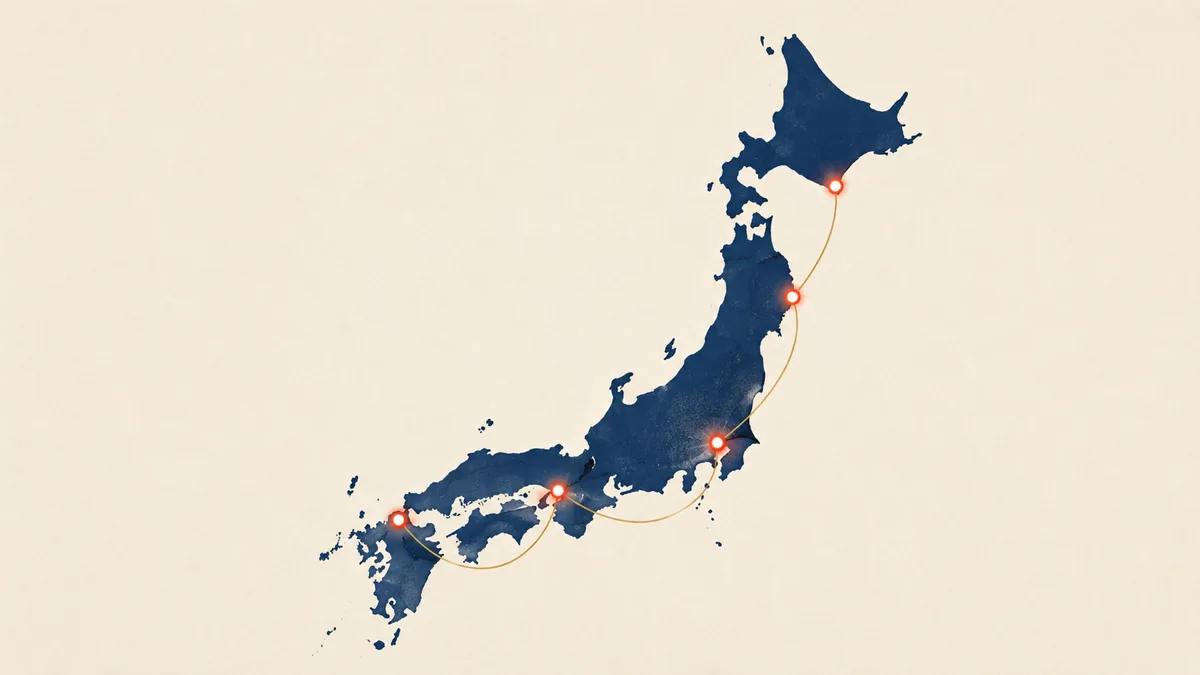
What makes the business interesting is concentration. Kamigumi holds the leading share of harbor-transportation services at Japan's six major ports—Tokyo, Yokohama, Nagoya, Osaka, Kobe, and Moji. Port operations are not a business you can spin up overnight: they require licenses, decades-old relationships, physical terminal infrastructure, and trained labor. That combination is a textbook economic moat—high barriers to entry protecting a business that the Japanese economy literally cannot function without.
For a US investor, the closest mental model is a regulated infrastructure operator: think of the defensive, toll-booth quality of a freight-rail or terminal business, rather than a fast-growing exporter. The revenue is tied to the steady flow of trade through Japan, not to a single product cycle.
The dividend story—and why it changed in 2026
Kamigumi's appeal to an income investor rests on two things: a respectable yield and, more importantly, a decade of consecutive dividend increases.
The forward dividend yield has recently sat in roughly the 3.8%–4.3% range depending on the share price on a given day—comfortably above the TOPIX average. But the yield is not the headline. The headline is the trajectory: a business that has lifted its payout every year for ten years is signaling durable, growing free cash flow. US investors who hunt for "Dividend Aristocrat"-style consistency will recognize the pattern, even if Kamigumi will never appear on a US screen.
The pivotal change came with the fiscal year ending March 2026, when Kamigumi adopted a performance-linked dividend policy targeting a consolidated payout ratio of around 70%. In plain English: the company has formally committed to returning the large majority of its profits to shareholders, rather than letting cash pile up on the balance sheet.
Why that 70% policy matters more than the yield
This is where a single stock connects to a market-wide story.

For decades, the knock on Japanese companies was that they hoarded cash—sitting on enormous balance sheets while earning low returns on equity and paying stingy dividends. Since 2023, the Tokyo Stock Exchange has been pushing listed companies, especially those trading below book value, to improve capital efficiency and shareholder returns. The result has been a wave of higher payouts and buybacks across the market.
Kamigumi's move to an explicit 70% payout target is that reform showing up in a single income statement. It is the difference between a company that happens to pay a decent dividend and one that has contractually committed itself to a shareholder-friendly capital policy. For an investor, a formal payout-ratio framework is far more durable than a discretionary dividend that management can quietly cut in a soft year.
A formal payout-ratio framework is far more durable than a discretionary dividend a board can quietly cut in a soft year.
On Japan's governance shift
That structural shift—companies being judged by what they return rather than what they hoard—is the single most important reason Japanese equities deserve a fresh look from US investors in 2026.
The numbers, briefly
A few figures to frame the valuation (reconstructed from public filings; confirm against the latest IR materials before relying on them):
- Forward P/E: roughly 19x
- Price-to-book: roughly 1.4x
- Recurring profit: on the order of ¥39–40 billion, growing in the high single digits year over year
- Payout policy: ~70% consolidated payout ratio, performance-linked
Two honest observations. First, at ~19x earnings and ~1.4x book, Kamigumi is not statistically cheap—this is not a Graham-style "net-net" or a deep-value rerating candidate. You are paying a fair price for quality and consistency, not buying a dollar for sixty cents. Second, the earnings growth is steady rather than explosive, which is exactly what you would expect from an infrastructure-like operator. The investment case, if there is one, is "defensive compounding," not "multi-bagger."
It helps to see how the same defensive-infrastructure profile looks from a US investor's chair, set against the kind of US-listed rail or terminal operator most American readers already know:
| Kamigumi (9364) | Typical US peer | |
|---|---|---|
| Forward dividend yield | ~4.0% | ~1.5–2.5% |
| Payout framework | Formal ~70% target | Progressive, no fixed ratio |
| Forward P/E | ~19x | ~18–22x |
| Currency for a US investor | Yen (FX risk) | US dollar (none) |
| Dividend withholding | 10% (US–Japan treaty) | None (domestic) |
| How you buy it | TSE direct, no major ADR | Standard US brokerage |
The takeaway is not that one is better than the other—it is that Kamigumi offers a meaningfully higher starting yield and a more explicit payout commitment, in exchange for currency risk and a less convenient buying process. That trade-off is the whole story of owning Japanese income stocks from the US.
How a US investor would actually access it
This is the part most US-centric articles skip. A few practical points:
- There is no major US-listed ADR for Kamigumi. You access the shares directly on the Tokyo Stock Exchange under ticker 9364.
- You need a broker that offers Japanese equities. Interactive Brokers is the most common route for US retail investors; some other international brokers offer Japan access, but many mainstream US brokerages do not.
- Dividends are paid in yen and subject to Japanese withholding tax. Under the US–Japan tax treaty, the rate on portfolio dividends for a US resident is generally 10% (reduced from the higher non-treaty rate when the proper documentation is on file). You can typically claim a US foreign tax credit for the Japanese tax withheld—but the mechanics depend on your account and situation, so confirm with your broker and a tax professional.
- You are taking a yen position. A weaker yen reduces the dollar value of both the share price and the dividend; a stronger yen does the opposite. This currency exposure is a feature of every Japanese-stock purchase, and it should be a deliberate decision, not an afterthought.
The risks
No profile is complete without the other side:
- Trade and port-volume cycles. Kamigumi's revenue tracks the flow of goods through Japan. A global trade slowdown, a recession, or a structural drop in import/export volume would pressure the business.
- Domestic concentration. The strength—dominance of Japanese ports—is also a concentration risk. This is overwhelmingly a bet on the Japanese economy.
- Valuation. At ~19x earnings, there is little margin of safety if growth stalls. Quality is priced in.
- Currency. Yen weakness can erode dollar returns even if the stock performs well in yen terms.
- Single-stock risk. Everything above is company-specific. A diversified Japan dividend basket or fund removes the idiosyncratic risk that a single name carries.
Bottom line
Kamigumi is not a thrilling stock, and that is the point. It is a dominant, infrastructure-like operator with a genuine moat, a ten-year record of rising dividends, and a newly formalized commitment to returning ~70% of profits to shareholders. It is a clean, concrete example of the capital-discipline shift reshaping Japanese equities—and a name that almost no US investor has on their radar.
Whether that makes it a fit for any particular portfolio is a question only you and a licensed advisor can answer. The reason to study it is the pattern it illustrates: high-quality, shareholder-friendly Japanese companies are hiding in unglamorous corners of a market that the rest of the world is still learning to take seriously.
- Kamigumi Co., Ltd. — Investor Relations (English)
- Japan Exchange Group (JPX) — listed-company information (English)
- Tokyo Stock Exchange — Action to Implement Management that is Conscious of Cost of Capital and Stock Price
- IRS — Publication 514, Foreign Tax Credit for Individuals
- IRS — Japan Tax Treaty Documents