Most US investors who venture into Japan reach for the obvious names: Toyota, Sony, Nintendo, or the trading houses Warren Buffett made famous. Almost no one reaches for a 130-year-old company that makes the ink inside the cereal box, the shampoo bottle, and the magazine on the table—and that quiet obscurity is exactly where the interesting valuations tend to hide.
Sakata INX (TSE: 4633) is the world's third-largest printing-ink manufacturer. It is an unglamorous, globally diversified industrial that trades at a single-digit price-to-earnings ratio, yields around 4.4%, and has lifted its dividend so aggressively that the payout has roughly tripled in five years. If Kamigumi is a story about paying a fair price for defensive quality, Sakata INX is the opposite end of the spectrum: a statistically cheap, cyclical industrial in the middle of a dividend-and-governance re-rating.
This profile is built from Sakata INX's primary disclosures and public market data, written for US and global investors from a Japan-based vantage point. It is a company profile for educational purposes—not a recommendation to buy or sell anything. The disclaimer is at the end.

What Sakata INX actually does
Sakata INX was founded in Osaka in 1896, originally making newspaper ink. Over more than a century it grew—organically and through acquisitions—into a genuinely global business: today it is the world's third-largest printing-ink manufacturer, with manufacturing and sales operations spread across more than twenty countries in Asia, the Americas, and Europe.
Ink sounds like a trivial product until you look at where it goes. Sakata's portfolio spans the major printing technologies an industrial economy runs on:
- Packaging inks (gravure and flexo) for the flexible film and cartons that wrap food, beverages, and consumer goods.
- Offset inks for commercial printing, catalogs, and publications.
- Newspaper inks, the company's original business.
- Specialty inks: UV/EB-curable, inkjet for digital printing, and inks for metal decorating (think beverage cans).
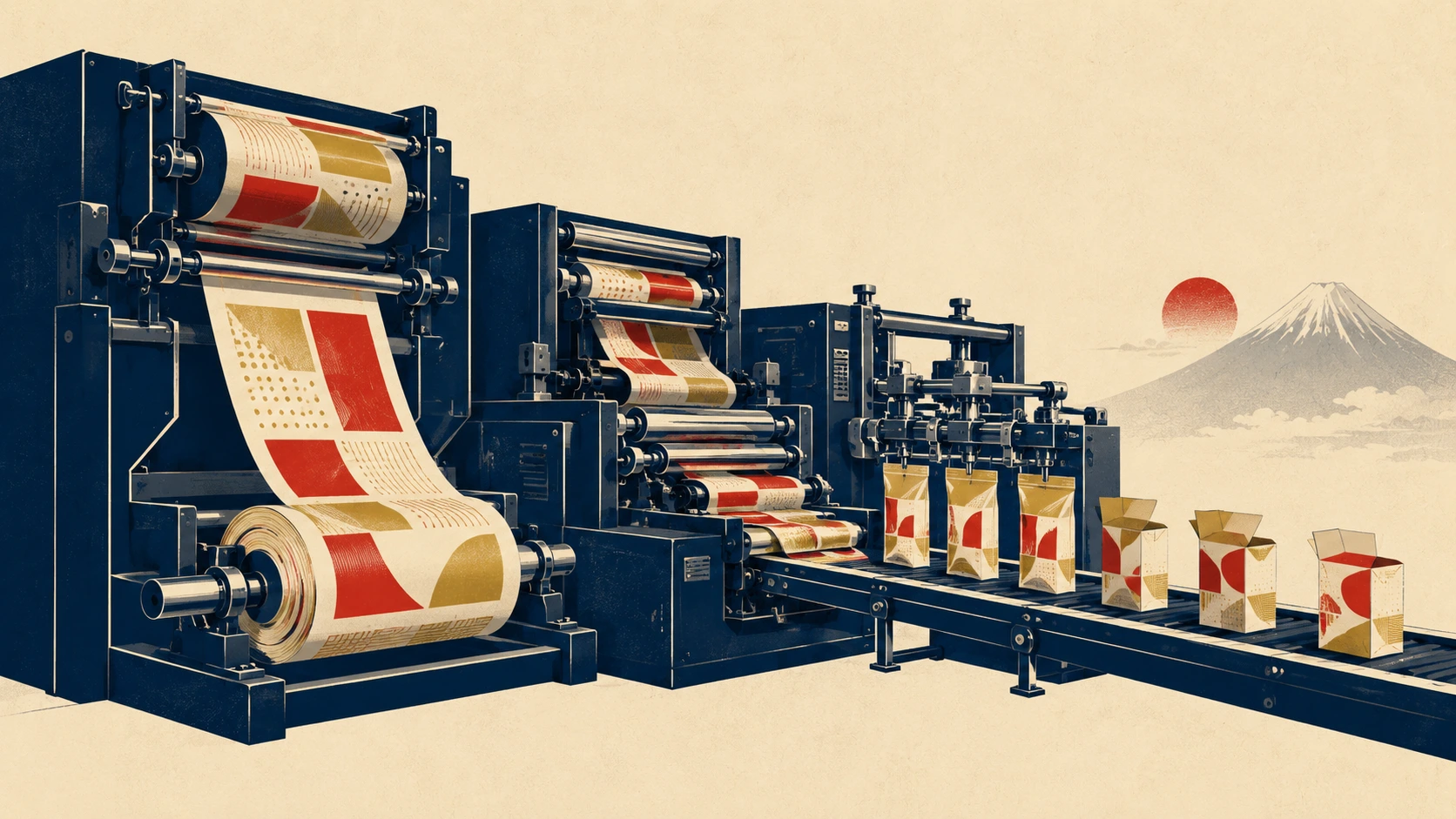
The mix matters enormously, because "printing ink" is not one market—it is two stories moving in opposite directions. Publication and newspaper printing is in structural decline as the world reads on screens. Packaging printing is resilient and growing, tied to consumption, e-commerce, and rising living standards in emerging Asia rather than to the fate of the printed page. Sakata's strategic tilt toward packaging—especially across Asia, where it has built a strong regional position—is what lets a company in a supposedly "dying" industry keep growing its profits.
- Structurally declining as readers move to screens
- Sakata INX's original 1896 business
- A shrinking share of the revenue mix
- Gravure & flexo inks for film, cartons, and labels
- Tied to consumption & e-commerce, not the printed page
- Growing fastest across emerging Asia
For a US investor, the closest mental model is a diversified specialty-chemicals supplier: a picks-and-shovels business that sells a consumable input into thousands of customers' production lines. Revenue is steady and recurring, but margins flex with the cost of raw materials—pigments, petrochemical-derived resins, and solvents—and with the yen.
The value case: why Sakata INX trades at a single-digit P/E
Here is what makes Sakata INX stand out on a screen. At a share price around ¥2,288 (late May 2026), the stock trades at a trailing P/E of roughly 9x, against trailing earnings per share of about ¥240. On forward estimates the multiple compresses further, toward the high single digits. By comparison, a quality Japanese compounder like Kamigumi changes hands near 19x, and the broad Japanese market sits in the mid-teens.
A single-digit earnings multiple on a profitable, globally diversified, century-old market leader is the kind of number that makes value investors look twice. It usually signals one of two things: either the market is mispricing a durable business, or it is correctly pricing a structural problem. With Sakata INX, the honest answer is some of both, and the entire investment debate lives in that tension.
The bearish read is straightforward: this is a cyclical, capital-intensive industrial whose biggest legacy market is shrinking, whose margins swing with commodity input costs, and which therefore deserves a low multiple. The bullish read is that the market is anchored to the word "ink" and the decline of newspapers, while underrating the packaging franchise, the global footprint, and—crucially—a management team that has pivoted hard toward returning cash to shareholders. Which story you believe is the whole game.
The Sakata INX dividend story—and why it changed
Whatever you conclude about the multiple, the dividend trajectory is hard to argue with. Sakata INX has raised its payout dramatically: the annual dividend per share has climbed from roughly ¥30 a few years ago to around ¥100 for the current year.
Two features of this dividend deserve a US income investor's attention. First, the growth rate has been exceptional—a near-tripling in five years, including a very large step-up in the most recent year. Second, and less obviously, the payout ratio is still only around 40%. A 4.4% yield that consumes less than half of earnings is structurally different from a 4.4% yield that consumes 80%: the former has room to keep rising even if profits merely hold steady, while the latter is stretched. Sakata's combination of a high starting yield and a low payout ratio is unusual, and it is the heart of the income case.
This did not happen in a vacuum. Since 2023, the Tokyo Stock Exchange has pressured listed companies—especially those trading below book value—to improve capital efficiency and shareholder returns. A cheap, cash-generative industrial sharply lifting its dividend and articulating clearer return targets is exactly what that reform looks like at the company level. Sakata INX is a textbook case of the governance shift reaching a name that global investors have almost entirely ignored.
A 4.4% yield that consumes less than half of earnings is structurally different from a 4.4% yield that consumes eighty percent.
On the income case
Sakata INX vs Kamigumi: two ways to own Japanese income
It is worth setting Sakata INX directly against the other single-stock profile in this series, because the two names illustrate opposite routes to a similar ~4% yield. One is the value route; the other is the quality route.
| Sakata INX (4633) | Kamigumi (9364) | |
|---|---|---|
| Investment style | Deep value + dividend growth | Defensive quality compounding |
| Forward P/E | ~7–9x | ~19x |
| Dividend yield | ~4.4% | ~4.0% |
| Payout framework | ~40% payout, fast-rising DPS | Formal ~70% target |
| Core business | Global printing inks (cyclical) | Japanese port logistics (infrastructure) |
| Main risk | Cyclicality + print-volume decline | Trade cycle + full valuation |
Neither is "better." Kamigumi asks you to pay up for a near-unassailable infrastructure moat and steady compounding. Sakata INX asks you to accept cyclicality and a shrinking legacy market in exchange for a single-digit multiple and a faster-growing dividend. A value investor leans toward 4633; an investor who prizes business quality and predictability leans toward 9364. Recognizing which kind of investor you are matters more than the specific tickers.
How to buy Sakata INX (4633) from the US
This is the part most US-centric coverage skips. The practical route is short:
- Open a brokerage with Japanese-equity accessInteractive Brokers is the common route for US retail investors; many mainstream US brokers lack direct Tokyo access.
- Buy ticker 4633 on the Tokyo Stock ExchangeThere is no major US-listed ADR, so you hold the shares in yen on the TSE itself.
- Receive dividends in yen, net of 10% withholdingThe reduced rate applies under the US-Japan tax treaty when your documentation is on file.
- Hold the position deliberately in yenA weaker yen lowers your dollar returns; a stronger yen lifts them.
The same path, with the details that matter:
- There is no major US-listed ADR for Sakata INX. You buy the shares directly on the Tokyo Stock Exchange under ticker 4633.
- You need a broker that offers Japanese equities. Interactive Brokers is the most common route for US retail investors; many mainstream US brokerages do not offer direct Tokyo access.
- Dividends are paid in yen and subject to Japanese withholding tax. Under the US–Japan tax treaty, the rate on portfolio dividends for a US resident is generally 10% (with the proper documentation on file). You can typically claim a US foreign tax credit for the Japanese tax withheld, but the mechanics depend on your account—confirm with your broker and a tax professional.
- Note the December fiscal year-end. Unlike many Japanese companies that close their books in March, Sakata INX runs a calendar-year fiscal cycle, which affects dividend record dates and reporting timing.
- You are taking a yen position. A weaker yen reduces the dollar value of both the share price and the dividend; a stronger yen does the opposite. This currency exposure is a feature of every Japanese-stock purchase and should be a deliberate decision.
The risks of owning Sakata INX
A single-digit multiple is a warning label as much as an invitation. The honest list:

- Structural decline in publication printing. The bear case is real: newspaper and commercial-print ink demand is shrinking. The bull case depends entirely on packaging inks growing fast enough to more than offset it. If that pivot stalls, the cheap multiple is deserved.
- Input-cost and margin cyclicality. Pigments, resins, and solvents are commodity inputs tied to oil and petrochemicals. Margins can compress quickly when raw-material prices spike, and ink makers cannot always pass costs through immediately.
- The re-rating has already happened. The shares have risen sharply over the past year as the dividend story took hold. The deepest part of the discount may already be closed; buying now is a bet on continued execution, not on an obvious mispricing.
- Currency. Yen weakness can erode dollar returns even if the stock performs well in yen terms—though a globally diversified earnings base provides some natural offset.
- Single-stock risk. Everything here is company-specific. A diversified Japan value or dividend basket removes the idiosyncratic risk a single name carries.
Frequently asked questions
- How can a US investor buy Sakata INX (4633) stock?
- There is no major US-listed ADR for Sakata INX, so you buy the shares directly on the Tokyo Stock Exchange under ticker 4633, through a broker that offers Japanese equities—Interactive Brokers is the most common route for US retail investors. Dividends are paid in yen and are subject to a 10% Japanese withholding tax under the US–Japan tax treaty.
- What is Sakata INX's dividend yield?
- The shares yielded roughly 4.4% in late May 2026, at a price around 2,288 yen. The annual dividend per share has climbed from about 30 yen to roughly 100 yen over five years, on a payout ratio of only around 40%—leaving room to keep rising. Figures are approximate; confirm against official filings.
- Why is Sakata INX's P/E so low?
- It trades around 9x trailing earnings (high-single-digits on a forward basis) because it is a cyclical industrial whose largest legacy market—publication and newspaper printing—is in structural decline. The bull case is that its growing packaging-ink franchise and rising shareholder returns are underappreciated by the market.
- Is Sakata INX a value trap?
- It is a genuine risk. The low multiple is partly deserved, given the decline of printed media and the margin swings of a commodity-input business. The case rests on packaging inks growing fast enough to offset that decline, and on continued dividend discipline—and note that the shares have already re-rated sharply over the past year.
- What does Sakata INX do?
- Founded in Osaka in 1896, Sakata INX is the world's third-largest printing-ink manufacturer, operating in more than 20 countries. It makes packaging (gravure and flexo) inks, offset inks for commercial printing, newspaper inks, and specialty inks such as UV/EB-curable, inkjet, and metal-decorating inks.
Bottom line
Sakata INX is the kind of company value investors are supposed to love and the market is built to ignore: a 130-year-old, globally diversified market leader in an unfashionable industry, trading in single digits, paying a 4%-plus dividend that is rising fast off a conservative payout ratio. It is a clean, concrete example of the capital-discipline shift reshaping Japanese equities—reaching a name almost no US investor has ever heard of.
The catch, and it is a real one, is that the discount exists for a reason: this is a cyclical industrial wrestling with the slow decline of printed media, and the easy re-rating may already be behind it. Whether the packaging franchise and the dividend trajectory are enough to justify the case is a question only you and a licensed advisor can answer. The reason to study it is the pattern: when the rest of the world is still learning to take Japanese equities seriously, the cheapest opportunities are usually hiding in the corners no one bothers to look in.
- Sakata INX Corporation — Investor Relations (English)
- Sakata INX Corporation — Company history (English)
- Japan Exchange Group (JPX) — listed-company information (English)
- Tokyo Stock Exchange — Action to Implement Management that is Conscious of Cost of Capital and Stock Price
- IRS — Publication 514, Foreign Tax Credit for Individuals
- IRS — Japan Tax Treaty Documents