When Berkshire Hathaway disclosed in August 2020 that it had quietly accumulated roughly 5% stakes in each of Japan's five largest trading houses—Itochu, Mitsubishi Corporation, Mitsui & Co., Sumitomo Corporation, and Marubeni—most US investors had never heard of a sogo shosha. Five years later, those positions have become one of the most instructive value-investing case studies of the decade.
This is not a stock tip. It is a study of why one of the most disciplined capital allocators alive went shopping in a market that US investors had written off for thirty years—and what that reasoning looks like when you trace it back to its sources.
Disclosure: this article contains affiliate links. If you buy a book through one of them, this site may earn a small commission at no additional cost to you. The book selections reflect my own reading and are not influenced by commissions.
Informational only. The disclaimer is at the end.

What a sogo shosha actually is
A sogo shosha ("general trading company") has no clean US analog. The closest mental model is a hybrid of a commodities trader, a private-equity holding company, and a logistics and project-finance arm—all under one listed roof. Mitsubishi Corporation alone touches energy, metals, machinery, chemicals, food, and consumer businesses across dozens of countries.
For decades, Western investors treated these conglomerates as un-analyzable black boxes: sprawling, opaque, and trading at a discount for good reason. That perception is exactly what created the opportunity.
The three things Buffett saw
Strip away the mystique and the thesis was almost boringly classical:
-
Cheap on plain numbers. When Berkshire was buying, several of the trading houses traded below book value with single-digit price-to-earnings ratios and dividend yields well above the Japanese market average. This is Graham-style "buying a dollar for sixty cents" territory.
-
Improving shareholder returns. The trading houses had begun returning more capital through dividends and buybacks—part of the same Tokyo Stock Exchange governance shift that has been reshaping the entire market. Cheap and getting friendlier to shareholders is a powerful combination.
-
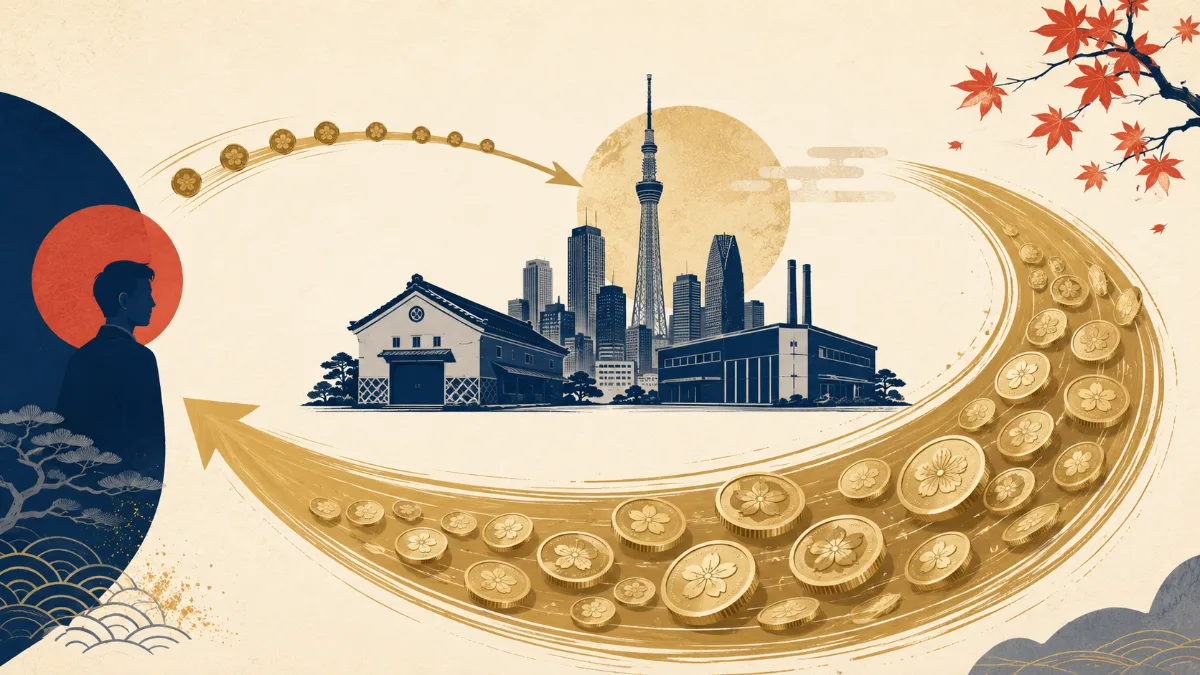
A currency trick that de-risked the whole thing. Berkshire funded much of the purchase by issuing yen-denominated bonds at very low interest rates. That means the yen value of the debt and the yen value of the assets move together—so a weaker yen does not blow up the trade the way it would for an unhedged dollar buyer. The dividends received in yen comfortably exceed the interest paid in yen. This is the detail most retail commentary misses, and it is the most important one.
Why this matters to a US investor specifically
You and I cannot issue yen bonds at institutional rates. So the literal trade is not replicable. But the lessons translate cleanly:
- Currency is a position, not a footnote. If you buy Japanese equities from a US brokerage in dollars, you are also taking a yen position whether you want one or not. Buffett's structure is a reminder to decide that exposure deliberately rather than by accident.
- "Boring and hated" is where value lives. The sogo shosha were ignored precisely because they were hard to model. Discomfort and opportunity often share an address.
- Capital-return trends compound. A rising payout ratio on an already-cheap base is the quiet engine here—far more durable than any single earnings beat.
The sogo shosha were ignored precisely because they were hard to model. Discomfort and opportunity often share an address.
Where value tends to live
| Berkshire's structure | A US retail buyer | |
|---|---|---|
| Funding | Low-cost yen bonds | US dollars from a brokerage |
| Currency effect | Yen assets vs yen debt — naturally hedged | Unhedged yen exposure |
| Income vs cost | Yen dividends exceed yen interest | Dividends only, received in yen |
| Holding period | Effectively permanent | Your choice |
| Replicable by you? | No (institutional rates) | Yes — with eyes open |
For the mechanics of how a US-based investor actually accesses names like these—ADRs, tickers, withholding tax, and currency considerations—see our companion notes on Japanese dividends and market structure elsewhere on this site.
The two books that explain the thinking
If you want to understand the reasoning rather than just the headline, two books do almost all of the work.
The first is The Essays of Warren Buffett: Lessons for Corporate America, Lawrence Cunningham's topically arranged collection of Buffett's shareholder letters. It is the closest thing to hearing Buffett explain, in his own words, how he thinks about valuation, owner earnings, and what makes a business worth holding for twenty years. Read it and the Japan trade stops looking exotic and starts looking inevitable.
The second is the source code for all of it: Benjamin Graham's The Intelligent Investor, the revised edition with Jason Zweig's modern commentary. Buffett has called it "by far the best book on investing ever written." The concepts that make the sogo shosha thesis work—margin of safety, Mr. Market, the difference between price and value—all originate here. The Zweig footnotes are worth the cover price on their own for translating Graham's 1949 prose into present-day examples.
You do not need both at once. Start with whichever matches your appetite: The Essays if you want the practitioner's voice, The Intelligent Investor if you want the first principles.
The honest caveats
A few things worth saying plainly:
- The easy money in this trade has already been made. The valuations that existed in 2020 are gone; the stocks have re-rated substantially.
- Trading houses carry real commodity-cycle and global-demand risk. A cheap multiple does not remove that.
- "Buffett bought it" is the single worst reason to buy anything. The point of studying the trade is the method, not the ticker.
The value of this case study is that it shows the classic playbook working in a market most people had stopped looking at. That is a transferable skill. The specific stocks are not the lesson—the lens is.
Bottom line
Berkshire's Japan bet is a clean, modern demonstration of value investing fundamentals: buy cheap assets with improving shareholder returns, control your currency exposure deliberately, and be willing to look where others won't. The reasoning is fully documented in Buffett's own essays and in the Graham text that taught him. Read those two, and you will understand the trade far better than any single news article—including this one—can convey.